

If you've ever discovered mold growing in a bathroom, basement, crawlspace, or around a window, you've probably heard the same advice:
"Just spray it with bleach."
It's one of the most common pieces of mold advice—and unfortunately, one of the most misunderstood.
While bleach can make mold look like it's gone, it often fails to solve the real problem. In many situations, it may even give homeowners a false sense of security while mold continues to grow beneath the surface.
Let's separate fact from fiction.
Myth: Bleach Kills All Mold
Household bleach is an effective disinfectant for many bacteria and viruses, but mold behaves differently.
When mold is growing on a hard, non-porous surface such as glass, glazed tile, or metal, bleach may kill much of the visible growth.
However, most mold problems don't occur on those types of materials.
Instead, mold commonly grows on:
- Drywall
- Wood framing
- Ceiling drywall
- Carpet backing
- Insulation
- Upholstery
- Paper-faced building materials
These are porous materials, and that's where bleach begins to lose its effectiveness.
Why Bleach Doesn't Reach the Root of the Problem
Think of mold like a weed.
The visible mold you see is similar to the leaves above the ground.
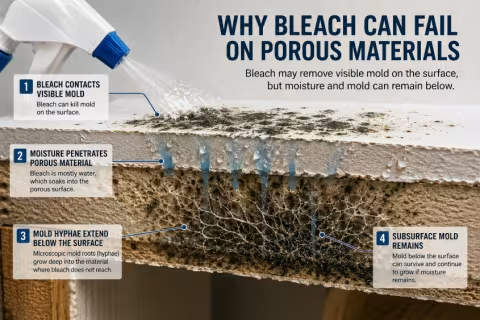
The real problem is the network of microscopic roots (called hyphae) that extend deep into porous materials.
Bleach is primarily water—typically around 90–95% water with a small percentage of sodium hypochlorite.
On porous materials:
- The water is absorbed deep into the material.
- The active bleach component stays mostly near the surface.
- Mold growing below the surface often survives.
- Remaining moisture can actually help surviving mold continue growing.
The stain may disappear, but the mold colony often remains alive.
Why Mold Sometimes Comes Back
Many homeowners have experienced this cycle:
- Spray bleach.
- Mold disappears.
- Everything looks clean.
- A few weeks or months later...
- The mold returns in exactly the same spot.
This happens because the source of the moisture wasn't corrected and the mold colony wasn't completely removed.
Cleaning the surface without addressing the underlying moisture problem is similar to painting over a water stain without repairing the leak.
Eventually, the issue comes back.
The Real Cause of Mold Growth
Mold requires only three things:
- Moisture
- Organic material to feed on
- Time
In many Nebraska homes, moisture comes from:
- Roof leaks
- Plumbing leaks
- Flooding
- Condensation
- High indoor humidity
- Foundation seepage
- Poor ventilation
If moisture remains, mold will continue to grow regardless of how many times bleach is applied.
That's why professional remediation focuses first on identifying and correcting the moisture source.
What Professional Mold Remediation Looks Like
Professional mold remediation involves much more than spraying a chemical.
A proper remediation typically includes:
Inspection
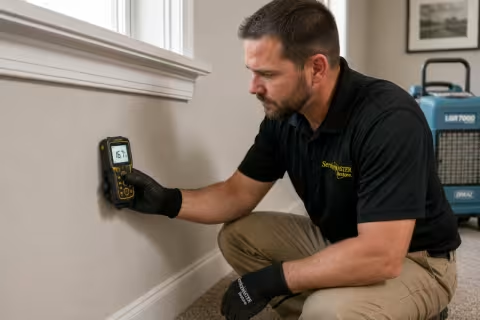
Technicians determine the extent of the contamination and locate the moisture source that allowed mold to develop.
Containment
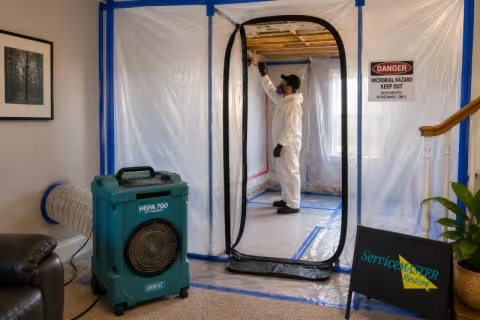
Affected areas are isolated to prevent microscopic spores from spreading throughout the home during removal.
Air Filtration
HEPA-filtered air scrubbers continuously remove airborne mold spores during the remediation process.
Safe Removal
Depending on the material, mold may be:
- HEPA vacuumed
- Professionally cleaned
- Wire brushed or media cleaned (when appropriate)
- Or removed entirely if the material cannot be safely restored
Drying
The affected area is thoroughly dried using commercial dehumidifiers and air movers so mold cannot continue growing.
Prevention
Finally, the moisture issue is corrected to reduce the likelihood of future mold growth.
When Is Bleach Appropriate?
Bleach isn't always the wrong choice.
For small amounts of mildew on non-porous surfaces, it can be an effective cleaner.
Examples include:
- Bathroom tile
- Glass shower doors
- Certain countertops
- Metal fixtures
However, if mold is growing on drywall, wood, ceilings, insulation, or has resulted from a water loss, bleach alone is rarely the complete solution.
Warning Signs You Should Call a Professional
Consider having your property professionally evaluated if:
- Mold covers more than a small isolated area.
- Mold returns after cleaning.
- There is a persistent musty odor.
- The mold developed after flooding or water damage.
- You suspect mold inside walls, attics, or crawlspaces.
- Building materials are soft, swollen, or deteriorating.
- Occupants are experiencing unexplained allergy-like symptoms that seem worse indoors.
Early intervention is often less expensive than waiting until mold spreads into additional materials.
Final Thoughts
Bleach may remove visible stains, but it rarely addresses the reason mold developed in the first place.
Successful mold remediation isn't just about killing mold—it's about removing contamination, controlling airborne spores, correcting moisture problems, and restoring a healthy indoor environment.
If mold keeps returning, there's usually a reason. Finding and correcting that reason is what makes the difference between a temporary cleanup and a lasting solution.
At ServiceMaster of Mid NE, our IICRC-certified technicians help homeowners identify moisture problems, safely remediate mold, and restore properties following water damage. Our goal isn't just to make mold disappear today—it's to help prevent it from coming back tomorrow.