

Can Water-Damaged Hardwood Floors Be Saved?
Understanding cupping, crowning, hidden moisture, and how professional drying can sometimes save hardwood flooring after water damage.
Hardwood flooring is one of the most attractive and valuable features in a home. But when water damage occurs, it can also become one of the most challenging materials to restore.
Whether the water comes from a burst pipe, leaking appliance, overflowing sink, or flooded room, homeowners often face an important question:
Can my hardwood floors be saved, or will they need to be replaced?
The answer isn't always obvious.
Hardwood floors that appear severely damaged may sometimes be restored through specialized drying techniques. Conversely, flooring that looks relatively normal on the surface may be concealing significant moisture beneath it.
Understanding how wood responds to moisture—and how professional restoration methods work—can make a substantial difference in the outcome.
Why Water Causes Hardwood Floors to Warp
Wood is a hygroscopic material, meaning it naturally absorbs and releases moisture in response to its surrounding environment.
Under normal conditions, hardwood flooring maintains a relatively stable moisture content based on the temperature and humidity inside the home.
When exposed to excessive moisture, however, wood fibers absorb water and expand.
The problem is that hardwood flooring doesn't always absorb moisture evenly.
Water may enter through seams between boards, penetrate unfinished edges, or accumulate beneath the flooring. This creates differences in moisture content between the top and bottom surfaces of individual boards.
Those differences can cause flooring to change shape.
Two of the most recognizable forms of hardwood floor distortion are cupping and crowning.
What Is Hardwood Floor Cupping?
Cupping occurs when the edges of individual hardwood boards rise higher than their centers, creating a shallow, concave appearance.
If you look across the floor at a low angle, the edges of the boards may appear raised, producing a noticeable washboard effect.
Cupping frequently develops when the underside of the flooring contains more moisture than the top surface.
For example, a leaking refrigerator supply line may allow water to travel beneath hardwood flooring. As the underside of the boards absorbs moisture and expands, the edges can begin to rise.
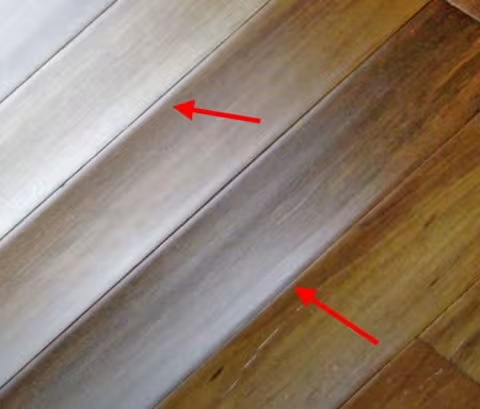
Does cupping mean the floor is ruined?
Not necessarily.
In some situations, cupped hardwood flooring can return substantially toward its original shape as the moisture content becomes more uniform and the wood reaches an appropriate moisture level.
However, recovery depends on several factors, including:
- The type and thickness of the hardwood flooring
- How long the flooring has been exposed to moisture
- The severity of the distortion
- The installation method and condition of the subfloor
- Whether the wood has experienced permanent deformation
One important caution: Sanding a cupped floor before it has thoroughly dried can create additional problems.
Removing material from the raised edges while the wood is still distorted can leave the floor uneven when it eventually returns toward its normal shape.
What Is Hardwood Floor Crowning?
Crowning is essentially the opposite of cupping.
Instead of the edges being raised, the center of each hardwood board rises higher than its edges, creating a convex or rounded appearance.
Crowning may occur when the upper surface of the flooring contains more moisture than the underside.
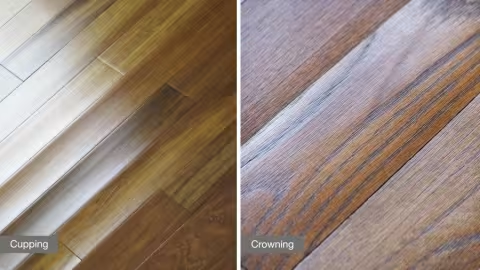
It can also develop when previously cupped flooring is sanded before it has sufficiently dried. As the boards gradually return toward their original shape, the sanded edges may end up lower than the centers.
This is one reason professional moisture evaluation is so important before attempting repairs.
A floor that appears dry is not necessarily ready to be sanded, refinished, or repaired.
The moisture content must be evaluated, not simply judged by appearance.
The Hidden Problem: Moisture Trapped Beneath Hardwood Flooring
One of the most misunderstood aspects of hardwood floor water damage is that the greatest moisture problem may be completely invisible.
Water can travel through seams between flooring boards and become trapped between the hardwood and the underlying materials.
Depending on the home's construction, moisture may accumulate in:
- Plywood or OSB subflooring
- Underlayment materials
- Adhesive layers
- The space between hardwood flooring and a concrete slab
- Adjacent wall cavities and structural materials
This trapped moisture can remain long after the visible surface appears dry.
For example, imagine a dishwasher supply line leaks overnight onto a hardwood kitchen floor.
The homeowner cleans up the standing water the next morning and places fans in the room.
Within a day or two, the surface may feel completely dry.
But water may have already migrated beneath the flooring, where evaporation is much slower.
Over time, this hidden moisture can contribute to cupping, deterioration of adhesives, subfloor damage, and conditions that support microbial growth.
Drying the surface of a hardwood floor is not the same as drying the entire flooring assembly.
That distinction is critical.
How Professionals Determine Whether Hardwood Flooring Can Be Saved
Before deciding whether hardwood flooring should be dried or removed, restoration professionals evaluate several important factors.
1. The Source and Category of Water
Not all water damage presents the same risks.
Water from a broken potable-water supply line is substantially different from water originating from a sewer backup.
Water contamination, exposure conditions, and the materials affected all influence whether restoration is appropriate.
Flooring exposed to sewage or other significant contamination may require removal rather than attempts to dry it in place.
2. How Long the Flooring Has Been Wet
Time is an important factor in hardwood floor restoration.
The longer moisture remains within the flooring system, the greater the potential for swelling, distortion, adhesive failure, and microbial growth.
Prompt professional intervention can improve the chances of successful restoration, although it cannot guarantee that flooring will be saved.
3. Moisture Content of the Flooring and Subfloor
Professional restoration technicians use moisture meters and other diagnostic equipment to assess moisture conditions.
Pin-type moisture meters can help evaluate moisture content at different depths within wood materials.
Other instruments may assist in identifying moisture patterns and determining where additional investigation is needed.
Measurements are compared with appropriate dry reference conditions and monitored throughout the drying process.
The objective is not simply to make the surface feel dry.
The objective is to return affected materials to appropriate moisture conditions without causing additional damage.
4. Type of Hardwood and Installation Method
Solid hardwood, engineered hardwood, and laminate flooring do not respond identically to water exposure.
Solid hardwood can sometimes tolerate controlled drying and recover from moderate distortion.
Engineered hardwood presents additional considerations because its layers are bonded together. Prolonged moisture exposure may cause delamination, swelling, or adhesive failure.
Laminate flooring is particularly vulnerable to irreversible swelling of its core material and generally has more limited restoration potential after significant water intrusion.
Installation methods also matter.
Nailed-down flooring, glued-down flooring, and floating floor systems can require different evaluation and drying approaches.
Specialty Drying Systems: Can Hardwood Floors Be Dried Without Removal?
In certain situations, professional restoration companies can use specialized drying systems designed to remove moisture from hardwood flooring assemblies.
These systems can sometimes reduce or eliminate the need to remove otherwise salvageable flooring.
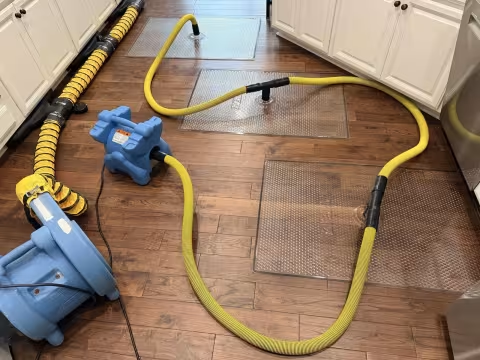
One approach involves using a floor drying mat system connected to specialized drying equipment.
The mats are placed over affected sections of flooring and connected to equipment that creates controlled suction.
<escape>[Suggested supporting image: A professional hardwood floor drying mat system installed across a water-damaged floor.]</escape>
The system is designed to encourage moisture movement and evaporation from within the flooring assembly.
Depending on the equipment, flooring construction, and installation conditions, these systems may help remove moisture from beneath the flooring without immediately tearing it out.
Other drying techniques may involve carefully controlled airflow, dehumidification, temperature management, or access to affected cavities.
Throughout the process, technicians monitor moisture readings and adjust the drying strategy as necessary.
It is important to understand that specialty drying is not a guaranteed solution.
Its effectiveness depends on the condition of the materials, how the flooring was installed, the extent of water intrusion, and whether moisture can be effectively removed.
Nevertheless, when conditions are appropriate, these techniques can offer homeowners a valuable alternative to complete floor replacement.
Why Simply Running Fans May Not Be Enough
When homeowners discover water on hardwood flooring, their first instinct is often to place household fans around the affected area.
While air movement can assist evaporation, it may not adequately address moisture trapped beneath flooring.
In some circumstances, aggressive surface drying without addressing underlying moisture can contribute to uneven moisture conditions within the boards.
Professional structural drying takes a more comprehensive approach.
Technicians consider the relationship between air temperature, relative humidity, airflow, material moisture content, and evaporation.
Commercial dehumidifiers help remove moisture from the surrounding air, while properly selected drying equipment promotes moisture movement from affected materials.
The process requires ongoing evaluation rather than simply leaving equipment running for a predetermined number of days.
When Does Hardwood Flooring Need to Be Replaced?
Although many hardwood floors are candidates for restoration, some damage is too extensive for drying alone.
Replacement may become necessary when:
Severe warping or buckling has occurred. Boards that have lifted substantially from the subfloor, separated, or experienced permanent deformation may not return to an acceptable condition.
The flooring has experienced prolonged moisture exposure. Extended wet conditions can lead to deterioration, loss of dimensional stability, and damage to underlying materials.
Adhesives or flooring layers have failed. Engineered hardwood that has delaminated or glued-down flooring that has lost its bond may not be suitable for restoration.
The water is significantly contaminated. Sewage and other contaminated water sources can make removal necessary based on the contamination, exposure, and ability to adequately clean affected materials.
The subfloor has sustained significant damage. Even if the hardwood itself appears salvageable, deterioration or loss of structural integrity beneath it may require removal to complete repairs.
The flooring cannot be restored to an acceptable condition. Permanent distortion, damaged finishes, staining, or other physical changes may make replacement the more practical option.
The decision should be based on a thorough evaluation rather than appearance alone.
Should Hardwood Floors Be Sanded Immediately After Water Damage?
Generally, no.
Sanding or refinishing hardwood flooring before it has reached appropriate moisture conditions can permanently alter its shape.
For example, a cupped floor may be sanded flat while the edges are still raised.
As the flooring continues drying and the boards change shape, the centers may become higher than the edges, producing a crowned appearance.
This can turn a potentially recoverable floor into one requiring more extensive repairs.
Before sanding or refinishing, the flooring should be adequately dried, moisture conditions should be verified, and the wood should be allowed sufficient time to stabilize.
A qualified flooring professional can then determine whether refinishing is appropriate.
What Should Homeowners Do When Hardwood Floors Get Wet?
The first few hours after discovering water damage can be important.
If hardwood flooring becomes wet:
- Stop the water source if it is safe to do so. Shut off the appropriate water supply or arrange for necessary plumbing repairs.
- Remove standing water promptly. Use safe methods appropriate for the water source. Avoid contact with sewage or potentially contaminated water.
- Avoid applying direct heat. Excessive heat can create additional stress and uneven drying conditions within the wood.
- Do not sand or refinish the floor prematurely. Allow the flooring to be properly evaluated and dried first.
- Contact a professional water damage restoration company. Moisture testing can help determine whether water has migrated beneath the flooring and whether specialized drying is appropriate.
The sooner the flooring system is evaluated, the more options may be available.
Frequently Asked Questions About Water-Damaged Hardwood Floors
1. Can water-damaged hardwood floors return to normal?
Yes, in some cases. Hardwood floors that have experienced mild to moderate cupping may return substantially toward their original shape once properly dried. However, the outcome depends on the type of hardwood, the amount of moisture absorbed, how long the flooring remained wet, and whether permanent damage occurred. Professional moisture testing can help determine whether restoration is possible.
2. How long does it take to dry water-damaged hardwood floors?
Drying time varies considerably depending on the severity of water damage, flooring thickness, subfloor materials, and environmental conditions. Some flooring assemblies may dry within several days, while others require weeks of controlled drying. Professional restoration technicians monitor moisture levels throughout the process rather than relying on a predetermined drying schedule.
3. Will cupped hardwood floors flatten out after drying?
Sometimes. Cupping occurs when the edges of hardwood boards rise higher than their centers, often because the underside contains more moisture. As the flooring dries and moisture levels equalize, some cupping may gradually diminish. However, severe or prolonged distortion can become permanent. Hardwood flooring should not be sanded until it has adequately dried and stabilized.
4. Can water become trapped underneath hardwood flooring?
Yes. Water can penetrate seams between boards and accumulate beneath hardwood flooring, where it may affect plywood, OSB, underlayment, or other materials. The floor's surface may appear completely dry while moisture remains trapped underneath. Professional moisture meters and specialized drying equipment can help identify and address hidden moisture.
5. Can hardwood floors be dried without removing them?
In certain situations, yes. Professional restoration companies may use specialized hardwood floor drying mats, controlled suction, dehumidification, and other structural drying techniques to remove moisture from flooring assemblies. Whether these methods are appropriate depends on the flooring construction, contamination level, extent of damage, and condition of the underlying materials.
6. When should water-damaged hardwood floors be replaced?
Replacement may be necessary when flooring experiences severe buckling, permanent warping, delamination, adhesive failure, or significant structural deterioration. Flooring exposed to sewage or other serious contamination may also require removal. A professional evaluation can help determine whether drying and restoration are practical or replacement is the better option.
7. Can mold grow underneath water-damaged hardwood floors?
Yes. Moisture trapped beneath hardwood flooring can create conditions that support mold growth, particularly when moisture remains for an extended period. Mold may develop on susceptible materials such as wood subflooring or accumulated organic debris. Prompt water removal, moisture assessment, and appropriate structural drying can help reduce the risk.
8. Should I call a professional if my hardwood floors get wet?
Yes, particularly if water has entered the seams between boards, remained on the floor for an extended period, or may have reached the subfloor. Even when the surface looks dry, hidden moisture can cause additional damage. ServiceMaster of Mid NE, an IICRC Certified Firm, provides professional water damage restoration services throughout Lexington, North Platte, and surrounding Central Nebraska communities. A timely assessment can help determine whether your hardwood flooring can be saved.
The Bottom Line: Water-Damaged Hardwood Floors Aren't Always a Total Loss
Discovering water damage on an expensive hardwood floor can be discouraging.
But visible cupping, swelling, or other distortion does not automatically mean the entire floor must be replaced.
In some cases, professional moisture assessment and specialty drying equipment can help preserve flooring that might otherwise be unnecessarily removed.
In other situations, contamination, structural damage, or irreversible distortion makes replacement the safest and most practical choice.
The key is understanding what is happening beneath the surface, not just what can be seen from above.
At ServiceMaster of Mid NE, we understand the importance of evaluating affected materials, identifying hidden moisture, and developing an appropriate drying strategy before determining whether removal is necessary.
As an IICRC Certified Firm, we provide professional water damage restoration services for residential and commercial properties throughout Lexington, North Platte, and surrounding central Nebraska communities.
If your hardwood floors have been affected by water damage, a timely professional assessment can help determine whether restoration is possible before you commit to costly replacement.
ServiceMaster of Mid NE | Professional Water Damage Restoration | Serving Central Nebraska Since 1979